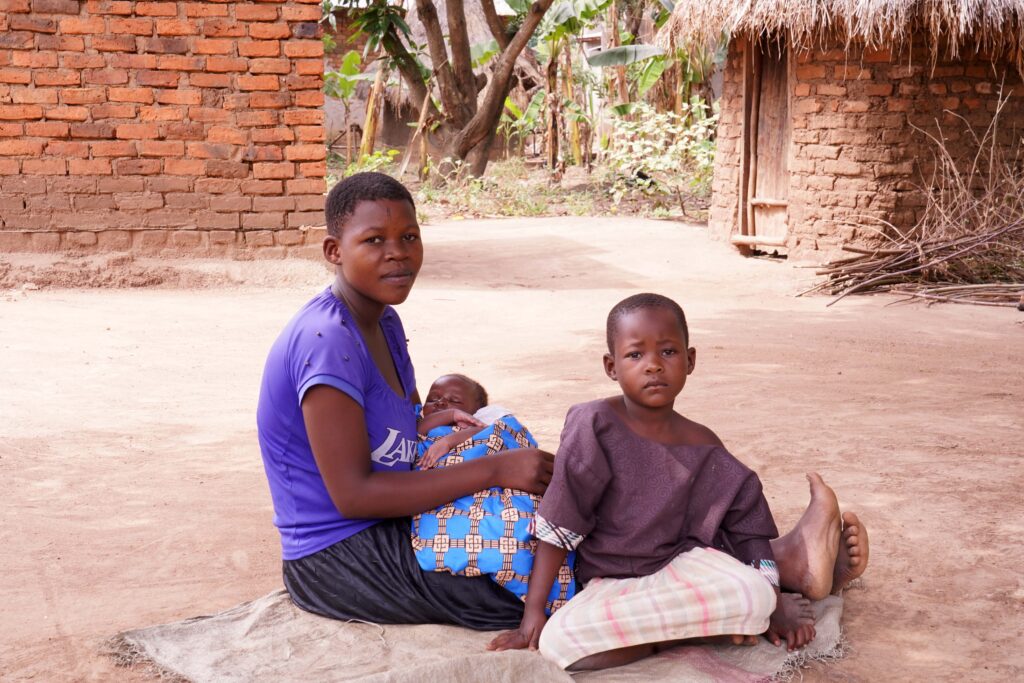
“IF I HAD NOT GONE FOR THE OUTREACH, I WOULD NOT HAVE KNOWN”.
SOPHIE’S JOURNEY FROM TEENAGE MOTHERHOOD TO SAFE DELIVERY.
At 13, Mugala Sophie was in Primary Six at Kaderuna Primary School in Kaderuna sub-county when her brother’s daughter became unwell.
The child felt feverish, and Sophie was sent to a nearby clinic to find out what was wrong.
She left home expecting to return after the child had been attended to.
Instead, on the way, she met a boy who convinced her to leave with him.
She followed him to his home and returned late that evening. Her parents were angry. They asked where she had been and told her to go back to where she had come from.
Sophie left home and went to stay with Nwara Wilson, the boy she had been seeing in Kabuna sub-county. She still thought about school and how she could continue her education while staying at his home.
Then COVID-19 came.
Schools closed, and Sophie never returned to Kaderuna Primary School. She remained at Nwara’s home, and the life she had imagined as a schoolgirl gradually gave way to a different one.
Nwara depended on casual work digging in people’s gardens. There was no regular income, and whatever he earned had to meet the needs of the young household.
At 14, Sophie became pregnant with her first child.
Her husband accompanied her to Budaka Health Centre IV for antenatal care. They were counselled together, tested for HIV, and taught about family planning, maternal health, and child nutrition.
For Sophie, having her husband by her side made her first pregnancy a shared experience.
“During my first pregnancy, my husband escorted me to the health facility. They talked to both of us and checked our HIV status. They also taught us about family planning and how to take care of the baby.”
The lessons gave her information, but life at home presented another reality.
There was little money.
As her first pregnancy approached its end, Nwara found casual work digging for someone. He earned a small amount of money and used it to buy clothes and essentials the baby would need.
“It was not much, but that is what he could afford,” Sophie says.
She then gave birth to a baby girl, her first child
She was now a young mother, trying to raise a child in a household where income depended on whether Nwara could find work.
When the child became sick, getting care was not always straightforward.
The health facility was far from home. Going there required money. Sometimes the family made the journey only to find the medicine they needed unavailable.
Sophie remembers what happened when that occurred.
“Sometimes we would go to the health facility, and they would write for us to go and buy the medicine because it was not there. If we had money, we would buy it. But when there was no money, it became difficult,” she says
So, some illnesses were watched at home. Sometimes the family used local remedies. And when they had money, they sometimes went directly to a nearby pharmacy rather than travelling to a health facility only to be referred elsewhere to buy medicine.
Then Sophie became pregnant again at 16
She gave birth to her second child, but the baby survived for only two weeks.
Sophie remembers that something had changed in the baby’s breathing.
“I remember the baby was breathing very fast, says Sophie. I wanted to take her to the health facility to find out what was causing it.”
But the health facility was far away. There was no money for transport, and Nwara did not have money to give her.
They waited, hoping the baby would improve.
Before Sophie could get the child to the health facility, the baby died.
Sophie does not know the medical cause of the death. What she remembers is the fast breathing, wanting to seek help, and being unable to get the baby to care in time.
She had lost a child.
Still, life moved on.
At 18, Sophie became pregnant again.
She continued attending antenatal care and hearing about family planning. But the information she received at the health facility existed alongside beliefs within her household that made the decision difficult.
Sophie says Nwara and members of his family did not want her to use family planning. They believed it could harm a woman’s body or cause babies to be born with big heads.
“They said that when a woman uses family planning, her ovaries can get burned, or she can give birth to children with big heads. Because of those beliefs, I did not use family planning.” Sophie recalled.
She gave birth to her third child.
Again, she had gone through pregnancy without an ultrasound.
At Budaka Health Centre IV, an ultrasound machine was available, but there had been a period when there was no trained sonographer to provide the service. Amina Nambozo, now a sonographer at the facility, had previously worked in the maternity ward before returning to school to train in sonography. She later returned to Budaka with the skills needed to provide the service.
The service had changed.
Sophie’s knowledge of the service had not.
She did not know that ultrasound scanning was now available at the health centre.
Then came her fourth pregnancy.
By the time Sophie was nine months pregnant, she was at home in Kabuna Sub-county, waiting to give birth. She had already gone through three pregnancies. She knew the experience of being pregnant. Nothing about that day told her that her baby was lying sideways.
Then a neighbour came to tell her about an outreach taking place at a nearby place.
The outreach was part of the Inclusive and Equitable Health Care Services (IEHS) Project, funded by German Doctors and implemented by the Uganda Youth and Adolescent Health Forum (UYAHF) to bring essential health information and services closer to underserved communities.
Sophie went for the outreach.
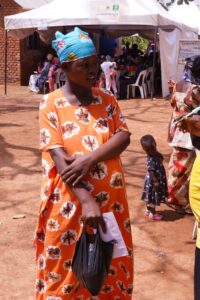
Sophie at the outreach site in Kabuna after being examined.
And for the first time in that pregnancy, she was examined using an ultrasound machine.
What she could not feel, the scan revealed.
Her baby was lying transversely.
Sophie was frightened.
But alongside the fear was another feeling: relief.
“When they told me the baby was lying the wrong way, I became scared. I kept thinking about my baby. But at the same time, I felt relieved because if I had not come for the outreach, I would never have known there was a problem.” Sophie shared.
For Amina, this is part of what makes access to ultrasound important, particularly for women who may feel well even when a pregnancy complication is developing.
“Many mothers come to these outreaches because they feel healthy. But not every pregnancy complication causes pain or obvious signs. Sometimes one scan is all it takes to detect a life-threatening condition early enough for us to act.” Amina explained.
Sophie was referred to Budaka Health Centre IV.
But this referral was not simply a piece of paper handed to her.
She was connected to VHT Naaya Geoffrey, who made an appointment with her and accompanied her to the health facility.
Naaya helped Sophie navigate the next step.
Naaya believes that a referral only matters if it leads to care. “Our work doesn’t stop after making a referral. We continue following up because we want every mother to reach the health facility and receive the care she needs. That’s how we help prevent emergencies.” He spoke
Sophie reached Budaka Health Centre IV.
She received care and delivered through a Caesarean section.
The delivery was successful.
She gave birth to a daughter.
But Naaya’s involvement did not end when Sophie left the health facility.
He continued to check on Sophie and the baby, following up to see how they were doing and whether there was anything they needed.
For Sophie, this pregnancy had unfolded differently.
There had been someone who helped identify the danger.
There had been someone to connect her to the health facility.
There had been someone to walk with her.
And there had been someone who returned afterwards to see how she and her baby were doing.
Yet the safe arrival of her daughter did not erase the challenges waiting for Sophie at home.
Her firstborn daughter is currently out of school because of school fees. She had been staying with her sister-in-law and attending school, but when the family could no longer meet the cost, she was sent back to Sophie.
Now she stays at home.
For Sophie, the situation carries a painful familiarity. Her own education ended when she was still a young girl.
She knows what it means for a child’s future to be interrupted by circumstances beyond the child’s control.
Her brother-in-law, Nalenya David, says poverty remains one of the biggest challenges facing families in the community.
For Nalenya David, the challenges go beyond access to healthcare; they are closely tied to the economic realities facing families in Budaka. “The biggest challenge we face around Budaka is lack of jobs. We only have to rely on casual labour to support ourselves and our families. When a mother gives birth, like in Sophie’s case, we don’t have much we can support her with. We only hope for the best. We try to walk them to the health facilities, but it’s only when they have the energy to reach there. But if we get something small, then we support them with transport to and back.”
The reality is not simply that Sophie lacked information.
She had been taught about nutrition during antenatal care.
She had been taught about family planning.
She had been taught about caring for her children.
But information exists within the circumstances in which people live.
A mother may know that she needs nutritious food while living in a household where food choices are shaped by poverty.
She may know that a sick child needs medical attention while lacking money for transport.
She may know where the health facility is while knowing from previous experience that medicine may not be available when she gets there.
And she may attend antenatal care without knowing that a service she once could not access has become available.
Sophie’s fourth pregnancy brought one of those changes into view.
A neighbour told her about an outreach.
She went.
The ultrasound revealed a problem she could not see.
The referral connected her to Budaka Health Centre IV.
Naaya walked with her.
She received the care she needed.
And her daughter was born safely.
For Sophie, the significance of that moment is perhaps best captured in the words she used to describe what might have happened if she had stayed home:
“If I had not come for the outreach, I would never have known there was a problem.”
Today, Sophie is still raising her children in difficult circumstances. Her firstborn daughter is out of school because of fees. The family continues to depend heavily on casual work. The memory of the child she lost remains part of her story.
The outreach did not solve all of those problems.
But it changed one critical moment.
It turned something invisible into something that could be acted upon.
And it showed what can happen when a health service reaches a woman where she is, when a referral is followed through, and when community health workers remain connected to her beyond the first encounter.
Sophie’s life has taken a path very different from the one she might have imagined as a Primary Six pupil.
She became a mother while still young. She experienced loss. She has navigated poverty, limited choices, and difficult access to healthcare.
But she still has hopes for her children.
She wants them to be healthy.
She wants them to go to school.
She wants to provide for them.
And, perhaps most importantly, she wants them to have opportunities she did not have.
Her story is not one of a problem that has been completely solved.
It is a story of what becomes possible when, at one critical moment, a woman can see the danger, reach the care she needs, and have someone walk with her through it.